A practical guide for factory management, production leaders and maintenance teams
In garment manufacturing, a cutting room delay rarely stays in the cutting room. When fabric is not spread, cut, numbered and bundled on schedule, sewing lines can wait for panels, production plans need revision and shipment pressure builds. For Bangladesh factories working with tight lead times and changing style mixes, reliable cutting-room output is both a productivity issue and a delivery issue.
Reducing downtime does not always require a major automation project. Much of the improvement comes from identifying recurring stoppages, maintaining cutting equipment before it fails, keeping the right replacement parts available and coordinating fabric, CAD, cutting and sewing teams around a realistic plan.
# What counts as cutting-room downtime?
Downtime is any period when planned cutting-room work cannot proceed at the expected rate. It includes more than a cutter sitting idle. Common examples include:
- An automatic cutter stopped while a technician diagnoses a fault or waits for a replacement part.
- A spreading table waiting for fabric, an approved marker or a revised cut plan.
- A lay held because fabric has not been inspected, relaxed or matched to the correct shade lot.
- Repeated knife changes, sharpening delays or poor cutting quality that forces recuts.
- Cut panels waiting for numbering, bundling, sorting or transfer to sewing.
- A machine running below its normal rate because its cutting consumables are worn or incorrectly fitted.
Factories should distinguish planned stops—such as scheduled cleaning and blade changes—from unplanned stops. Both consume capacity, but unplanned downtime is harder to schedule around and often causes more disruption downstream.
# Why cutting-room interruptions become expensive
The cutting room is an upstream production stage. A few lost hours can leave sewing lines without the style, size or color they are ready to assemble. Managers may respond by changing line priorities, moving operators or expediting unfinished bundles. These responses can create additional handling, confusion and work-in-progress.
Downtime can also affect fabric utilization and cut quality. A worn blade may cause fraying, inaccurate edges or incomplete cuts through a lay. A damaged or worn bristle surface can reduce support for the fabric during cutting. Poorly controlled roll allocation and marker changes can lead to avoidable remnants or recutting. The result is a combined loss of machine time, labor time and material value.
# 1. Measure stoppages before choosing a solution
Start with a simple downtime log for each spreading and cutting asset. Record the start and end time, machine or table, order/style, stoppage reason, action taken, parts used and whether production recovered as planned. Use specific reason codes such as:
| Downtime category | Examples to record |
| Machine fault | Cutter alarm, motor or sensor issue, electrical fault |
| Consumable or wear part | Blade, sharpening wheel, bristle block, belt |
| Material readiness | Fabric shortage, inspection hold, relaxation delay, shade mismatch |
| Planning or information | Marker unavailable, cut plan change, unclear priority |
| Staffing or skills | No trained operator, delayed maintenance support |
| Quality and rework | Recut, inaccurate panel, numbering or bundle correction |
Review the data weekly. Track total unplanned downtime, number of stoppages, average repair time, top causes by lost minutes and the share of orders completed to the cutting plan. A Pareto chart can help show whether a small number of recurring problems account for most lost time. Avoid treating every stop as a machine problem: sometimes the cutter is waiting because an upstream handoff is late.
# 2. Build preventive maintenance around the production calendar
Maintenance is more effective when it is scheduled before a high-volume order or a critical shipment window, rather than after a breakdown. Work with production planning to reserve short maintenance windows when a table or cutter is not required. For each machine model, use the manufacturer’s operating and maintenance guidance to define checks and intervals.
A practical routine can include:
- At shift start: confirm the machine is clean, guards and safety devices are in place, the blade is suitable for the job, and the operator has completed the required checks.
- During the shift: listen for unusual noise, watch for vibration or inconsistent cutting, and report repeated alarms early.
- At planned intervals: inspect wear parts, guides, belts, sharpening systems, cables and connections according to the equipment manual.
- After a repair: record the failure, part replaced, time to restore operation and any follow-up needed to prevent recurrence.
Do not wait for visibly poor cuts before inspecting a blade or sharpening system. Establish replacement criteria based on operating condition, cut quality and machine guidance. A routine inspection can reveal deterioration before it becomes a stoppage or quality problem.
# 3. Keep critical spares close to the machines that need them
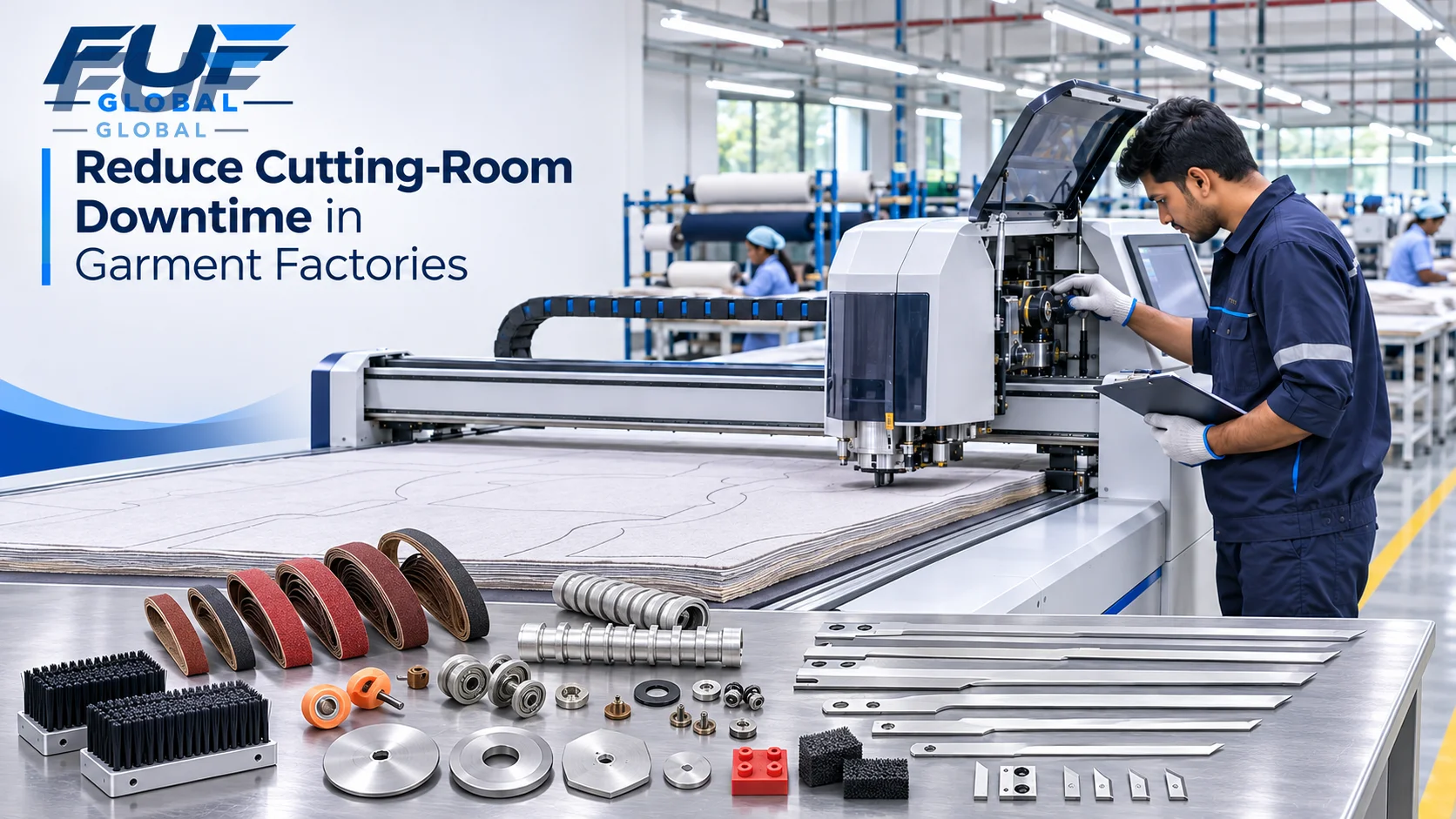
When a frequently used part is unavailable, a small component can hold up a high-value production process. Create a critical-spares list for each cutter model and rank items by failure frequency, lead time, production impact and compatibility risk. Typical cutting-room items to evaluate include cutting knives, sharpening components, bristle blocks or underlays, belts, bearings and selected electrical or motion-control parts.
Set minimum and reorder levels with maintenance and procurement, and label stock by machine model and part number. At breakdown time, technicians should be able to identify the required part from the machine record, not from guesswork. Keep a record of approved alternatives and compatibility checks; a part that looks similar may not fit or perform correctly.
FUF GLOBAL supplies garment machinery spares and cutting-machine items, including auto-cutter parts, knives, bristle blocks and related accessories. Factory teams can use its [cutting-machine parts catalog](https://fufglobal.com/shop/) to check available categories, then confirm the exact machine model, part number, dimensions and compatibility with the supplier before ordering. Its [contact page](https://fufglobal.com/) provides a route for product and sourcing enquiries. This is most useful when sourcing is tied to a documented spare-parts plan rather than an emergency search after a machine has stopped.
# 4. Use condition-based replacement for blades and bristle blocks
Consumables affect both uptime and cut quality. Replace or service blades when the manufacturer’s criteria, inspection findings or cut results indicate that they are no longer performing reliably. A poor blade can require slower cutting, extra passes or panel recutting.
Bristle blocks and underlays support the fabric as the cutter moves through a lay. Inspect them for uneven wear, damage, contamination or areas that no longer support the material consistently. Set a regular inspection routine and replace blocks in a controlled pattern so that worn sections do not create inconsistent cutting conditions across the table.
Store replacement items cleanly and protect cutting edges from damage. Train operators to report symptoms such as frayed edges, incomplete cuts, unusual vibration, repeated sharpening or declining cutting speed. These symptoms should trigger inspection, not an informal workaround that hides the underlying issue.
# 5. Improve fabric and marker readiness before the lay starts
Equipment cannot recover time lost to missing fabric or incomplete production information. Before a lay begins, confirm that:
- The correct fabric lot and quantity are available and released by inspection.
- Fabric relaxation requirements have been followed for the material and process.
- Shade grouping and roll allocation are clear.
- The approved marker, size ratio, ply count and cut order are available at the table.
- Any substitutions or order changes have been communicated to CAD, cutting and sewing.
Use a short readiness check at the start of each planned cut. If the order is not ready, record the reason and move to another approved job where possible. This prevents the team from repeatedly setting up a lay that cannot be completed.
# 6. Balance the cutting plan with sewing-line demand
Cutting-room efficiency is not simply the largest number of plies or bundles produced in a shift. The output must match sewing’s need by style, color, size and sequence. Production planning should translate line loading into a daily cut plan, with priorities visible to CAD, fabric store, cutting, quality and sewing.
Use clear rules for handling urgent orders and plan changes. Identify who can approve a change, how the revised marker or cut ratio reaches the floor, and how already-cut bundles are protected from mix-ups. Keep bundle identity and transfer status visible so that completed panels do not become hidden work-in-progress.
# 7. Train operators and technicians for first-response troubleshooting
Operators are often the first to notice a developing fault. Give them a simple, model-specific escalation guide that covers safe checks they are authorized to perform, warning signs that require stopping the machine, and who to contact. Maintenance staff should have access to machine manuals, electrical diagrams where applicable, service history and an updated spare-parts list.
Training should include correct blade handling, cleaning, routine checks, safe shutdown and restart, and how to record a fault accurately. Never bypass guards or safety interlocks to recover output. A faster restart is not a productivity gain if it increases risk or causes further equipment damage.
# 8. Reduce recovery time with a clear breakdown process
When a cutter stops, the team should know what happens next. A basic response process can be:
1. Stop the machine safely and protect the lay and work area.
2. Record the alarm or observed symptom and notify maintenance.
3. Check only the items the operator is trained and authorized to inspect.
4. Have maintenance identify the failure and the exact part or service required.
5. Confirm part compatibility and availability before fitting a replacement.
6. Test the machine safely, verify cut quality and update the downtime log.
7. Review whether the production plan needs resequencing and inform sewing promptly.
Measure mean time to repair alongside the number of breakdowns. If stoppage frequency is high, focus on preventing failures. If stoppages are infrequent but repairs take too long, improve fault information, technician readiness and spare-part availability.
# 9. Use a small set of management indicators
Factory leaders do not need a complicated dashboard to begin. Review a consistent set of indicators by machine and shift:
- Planned versus actual cutting output.
- Unplanned downtime minutes and top causes.
- Breakdown frequency and mean time to repair.
- Preventive-maintenance completion rate.
- Spare-part stockouts and emergency purchases.
- Recut or rejected-panel rate.
- Cutting-plan completion and on-time bundle handover to sewing.
Use the indicators to assign owners and dates to corrective actions. For example, if one cutter repeatedly stops because a specific consumable wears prematurely, maintenance can inspect operating conditions and supplier compatibility while procurement checks replenishment lead time. Review whether the action changed the result over the next few weeks.
# A 30-day starting plan
Week 1: Establish the baseline. Log each stoppage and record planned and actual cut output. Identify the three biggest causes of lost time.
Week 2: Fix readiness gaps. Confirm fabric, markers, cut ratios and order priorities are ready before laying. Review handoffs between fabric store, inspection, CAD and cutting.
Week 3: Strengthen maintenance and spares. Check high-impact wear parts, inspect machine condition and create a model-specific critical-spares list with reorder points.
Week 4: Review results and standardize. Compare downtime and plan completion with the baseline. Assign owners to remaining causes and update shift-start checks and breakdown records.
# Make uptime a shared production responsibility
Cutting-room downtime is rarely solved by one department alone. Production planning must provide a stable sequence, fabric and CAD teams must deliver ready inputs, operators must spot and report early symptoms, maintenance must prevent and diagnose failures, and procurement must keep compatible critical parts accessible.
For Bangladesh factories that rely on automatic cutting equipment, a disciplined maintenance routine and dependable access to the right replacement parts can protect both output and cut quality. FUF GLOBAL’s cutting-machine spares and consumables can support that approach when factories verify model and part compatibility and plan replenishment in advance. Start by measuring lost minutes, remove the most frequent causes and build a cutting room that hands complete, correctly identified bundles to sewing on time.
Need cutting-machine spares for your factory? Explore (https://fufglobal.com/shop/) or [contact FUF GLOBAL] (https://fufglobal.com/) with your machine model and part details to discuss sourcing.